
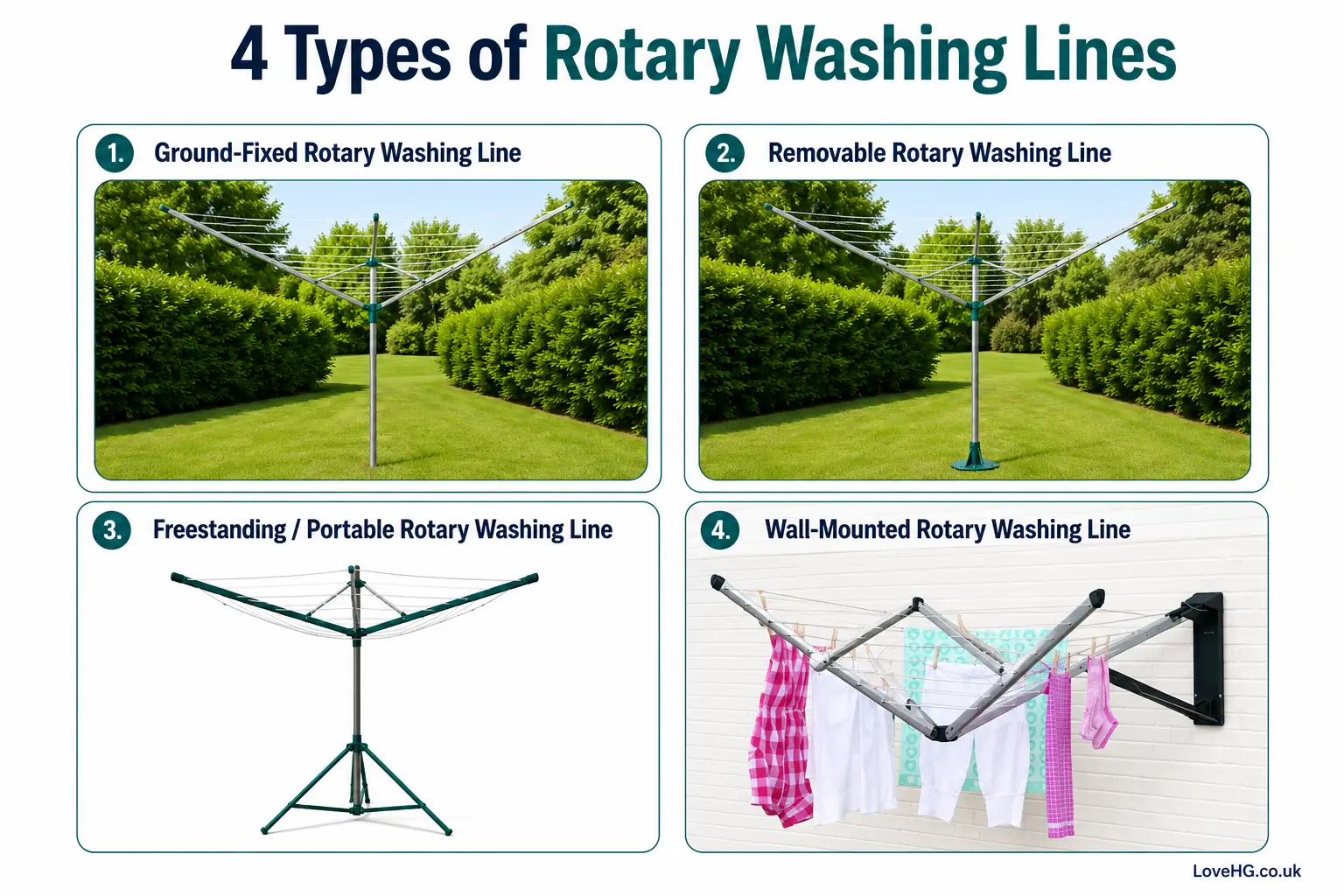
All Types of Rotary Washing Line
This article is about the different types of Rotary Washing Lines. Don’t confuse it with Washing Line Types
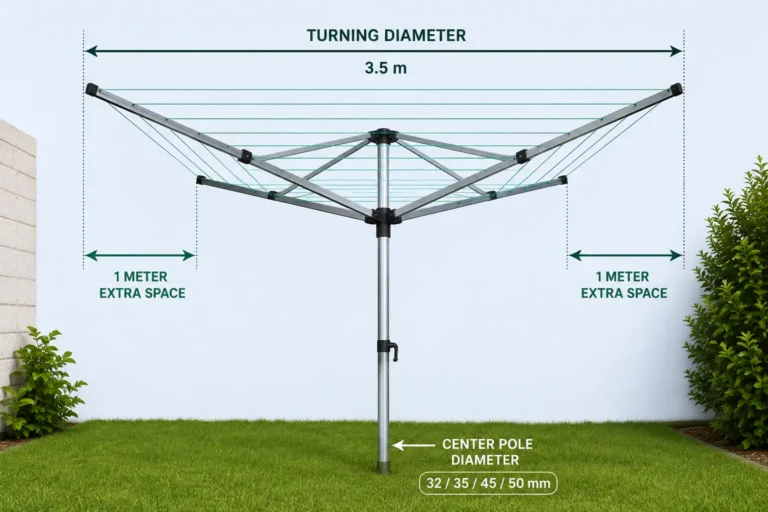
A rotary washing line is also known as a circular washing line or umbrella washing line because it rotates and opens and closes like an umbrella. It is installed outdoors, usually in a garden or similar place, to dry clothes naturally. It normally has 3 or 4 arms, and sometimes 5 arms, which can spin 360 degrees in the wind. This helps clothes dry evenly and more quickly.
There are several types of rotary washing lines, and they can be grouped into three main categories: structure and installation, size and capacity, and materials and durability. The structure and installation is the most important factor when choosing a rotary washing line because it determines where and how you can use it. Once you choose the right structure, you can then consider the size, capacity and material to find the best option for your needs.
4 Main Types of Rotary Washing Line by Structure & Installation
There are 4 main types of circular washing lines: fixed, removable, portable, and wall-mounted rotary washing lines. Each type is designed for different spaces and needs. Here are more details about each type:
1. Standard/Fixed Rotary Washing Lines (Ground-Fixed)
[ Best for a Large family laundry – Strongest – Most models are Foldable]
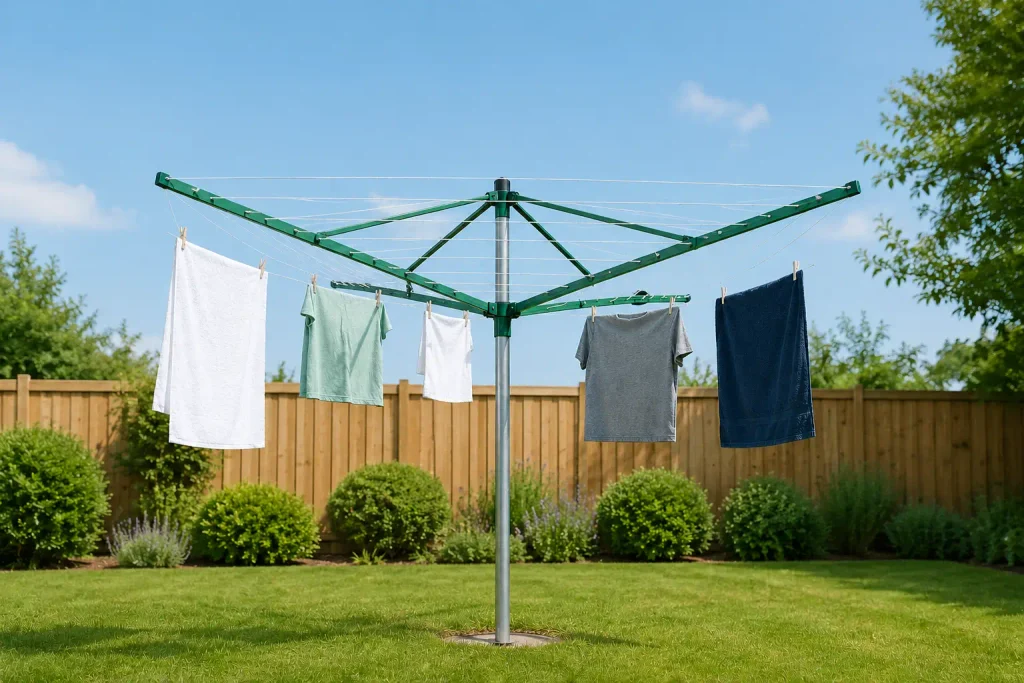
These standard rotary washing lines are the most popular choice in the UK and worldwide, with most people using this type to dry clothes faster. They are permanently fixed into the ground with concrete, while some models are installed directly into the ground, making them strong and stable, even in windy weather. These lines normally have four arms, providing plenty of space for drying clothes.
Most standard rotary washing lines feature a height-adjustable hoist, which can be a manual lift, Lift-O-Matic assisted lift, or Hoist system, making it easy to raise and lower the line for loading and drying laundry.
2. Removable Rotary Washing Line
[Best for a Small garden or limited space – All models are foldable ]
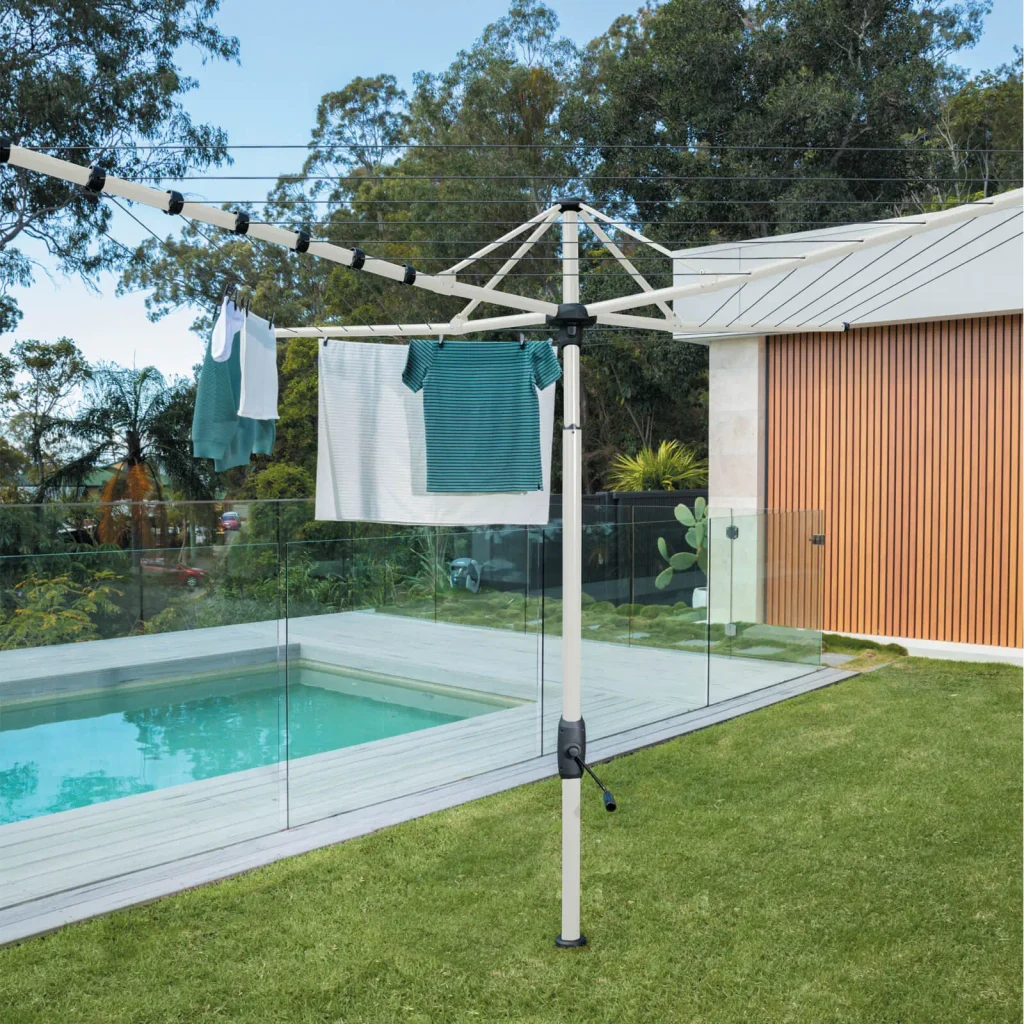
A removable rotary washing line is a type of washing line that fits into a ground socket. When not in use, it can be easily taken out, unlike fixed models, and the arms can be folded like an umbrella for storage in a shed or garage, helping to keep the garden tidy and clear. It is strong and works like a normal rotary line when in use, but offers more flexibility because it is not stuck in one place.
This type is best for people who want a neat outdoor space or only use the washing line sometimes.
Note: Folding arm features are available on both fixed and removable rotary washing lines.
3. Portable/Camping Rotary Washing Line (Freestanding with legs)
[Best for temporary use – Travelling – Both Indoor & Outdoor ]
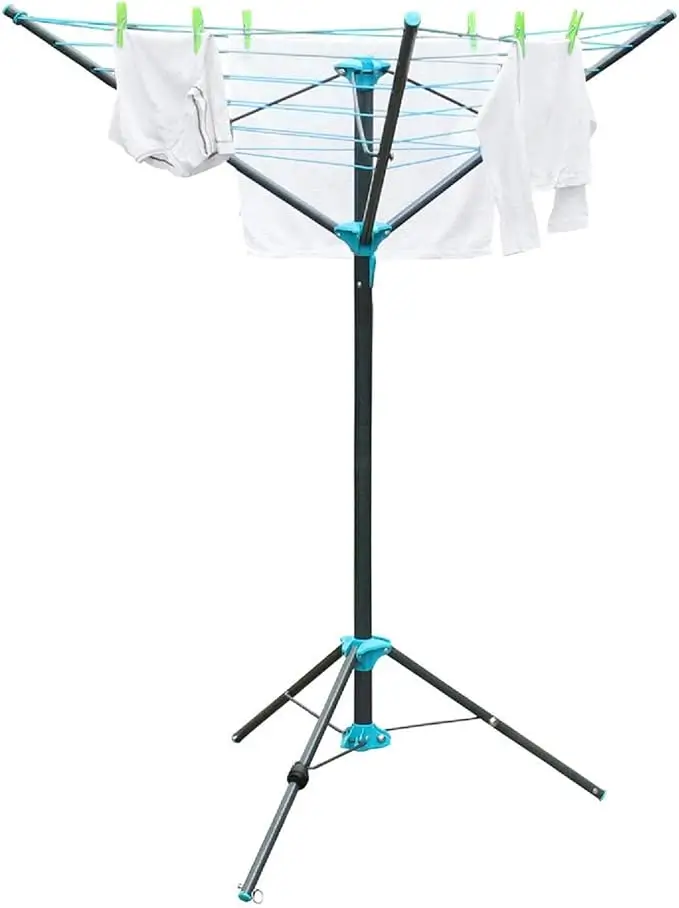
A portable rotary washing line is a freestanding type that comes with its own legs, so it does not need to be fixed into the ground. You can set it up anywhere outdoors, such as on a patio, lawn, or even a balcony, and move it easily when needed. It is simple to fold and store away, making it ideal for people who dry clothes occasionally or want a flexible drying option.
The downside of this portable rotary washing line is that it is not as strong as other rotary washing lines. It is lighter, so in strong winds or bad weather, it may fall over. This type is best for temporary use, for homes where permanent installation is not possible, or for those who want to use it both indoors and outdoors.
4. Wall-Mounted Rotary Washing Lines
[Best if no space on Ground- Both Indoor & Outdoor]

A wall-mounted rotary washing line works by attaching the washing line to a wall, usually outside your home. When you need to dry clothes, you pull the arms out, and the line can rotate so you can easily hang your laundry. Some models even rotate automatically if there is a breeze, helping clothes dry faster. Once you’re done, you can fold the line back against the wall to save space, making it ideal for small gardens, balconies, or areas where a full rotary washing line cannot fit.
These models typically have three arms and hold less laundry than freestanding ones, but they are very practical when space is limited.
Please note that not all wall-mounted washing lines rotate only some advanced models, such as Brabantia.
3 Types of Rotary Washing Line by Size & Capacity
Rotary washing lines are made in different sizes, and each size is designed for a different amount of washing. Choosing the right size helps your clothes dry faster and makes outdoor drying easier.
1. Smallest Rotary Washing Line (1 or 2 people)
Compact or Smallest rotary washing lines usually have a line length between 24m and 40m, with 3 or 4 arms. They typically span about 1.8m to 3.5m in diameter and can hold 2 to 3 loads of laundry. These are perfect for single people, couples, or small households with limited garden space.
This is enough for everyday washing for one or two people. It can hold items like shirts, trousers, underwear, and light towels without feeling overcrowded. This size is also a good choice if you do not wash large loads often.
2. Medium Rotary Washing Line (3 to 4 People)
Medium-sized rotary washing lines have around 40m to 50m of line length and usually 4 arms, with a diameter of 2.5m to 3.5m. They can handle 3 to 4 loads at a time, making them ideal for average-sized families or households with moderate laundry needs. It can handle clothes, towels, and smaller bedding items while still fitting well in most gardens.
3. Largest Rotary Washing Line (4 to 6 People)
Large or heavy-duty rotary washing lines offer 50m to 60m+ of line, with 4 arms and a span of 3.5m to 4.5m. They can hold 4 or more loads, making them suitable for bigger families, households with heavy laundry demands, or for drying bulky items such as bedding and blankets.
Large rotary washing lines can easily hold large items like bedsheets, duvet covers, and thick towels. However, they need a spacious garden to work properly.
4 Types of Rotary Washing Line by Materials & Durability
1. Aluminium
Aluminium rotary washing lines are very strong, rust-resistant, and last for a long time. They are lightweight, so they are easy to open, close, and move. They also need very little maintenance. However, aluminium washing lines are usually a bit more expensive than other types.
2. Galvanised Steel
Galvanised steel rotary washing lines are strong and good for holding heavy laundry like wet towels and bedding. They are coated to protect against rust, but this coating can wear off over time. If that happens, rust may start to appear. They are normally cheaper than aluminium.
3. Stainless Steel
Stainless steel rotary washing lines are extremely durable and highly resistant to rust and bad weather. They can last many years and need very little care. They are very strong and ideal for outdoor use. However, they are usually the most expensive option.
4. Plastic / Resin (Parts)
Plastic or resin is often used for small parts such as the centre hub or line holders. These materials do not rust and keep the washing line lightweight. However, plastic parts can become weak or crack after long exposure to the sun, cold, or heavy use, so they are less durable than metal parts.
Summary of the Article:
A rotary (umbrella) washing line is an outdoor tool for drying clothes quickly and evenly. There are four main types:
- Fixed/standard (strong and for large families)
- Removable (fits into a socket, ideal for small gardens)
- Portable (freestanding, easy to move, for temporary/camping use)
- Wall-mounted (space-saving, good for balconies)
Rotary lines also differ by size and capacity. Small lines are good for 1-2 people, medium for 3-4 people, and large/heavy-duty lines can handle big families or bulky items like bedding.
They are made from various materials for strength and durability. Aluminium lines are lightweight, rust-resistant, and low-maintenance. Galvanised steel is strong and affordable but may rust over time. Stainless steel is very durable and weather-resistant but more expensive, while plastic or resin parts keep lines lightweight but are less long-lasting.
I hope you now fully understand the different types of washing lines. If you have any questions, leave a comment below. If you’re looking to buy one, check out our guide: Best Rotary Washing Line.

9 Comments