Ultimate Guide to Rotary Washing Lines: Types, Benefits, Uses & More
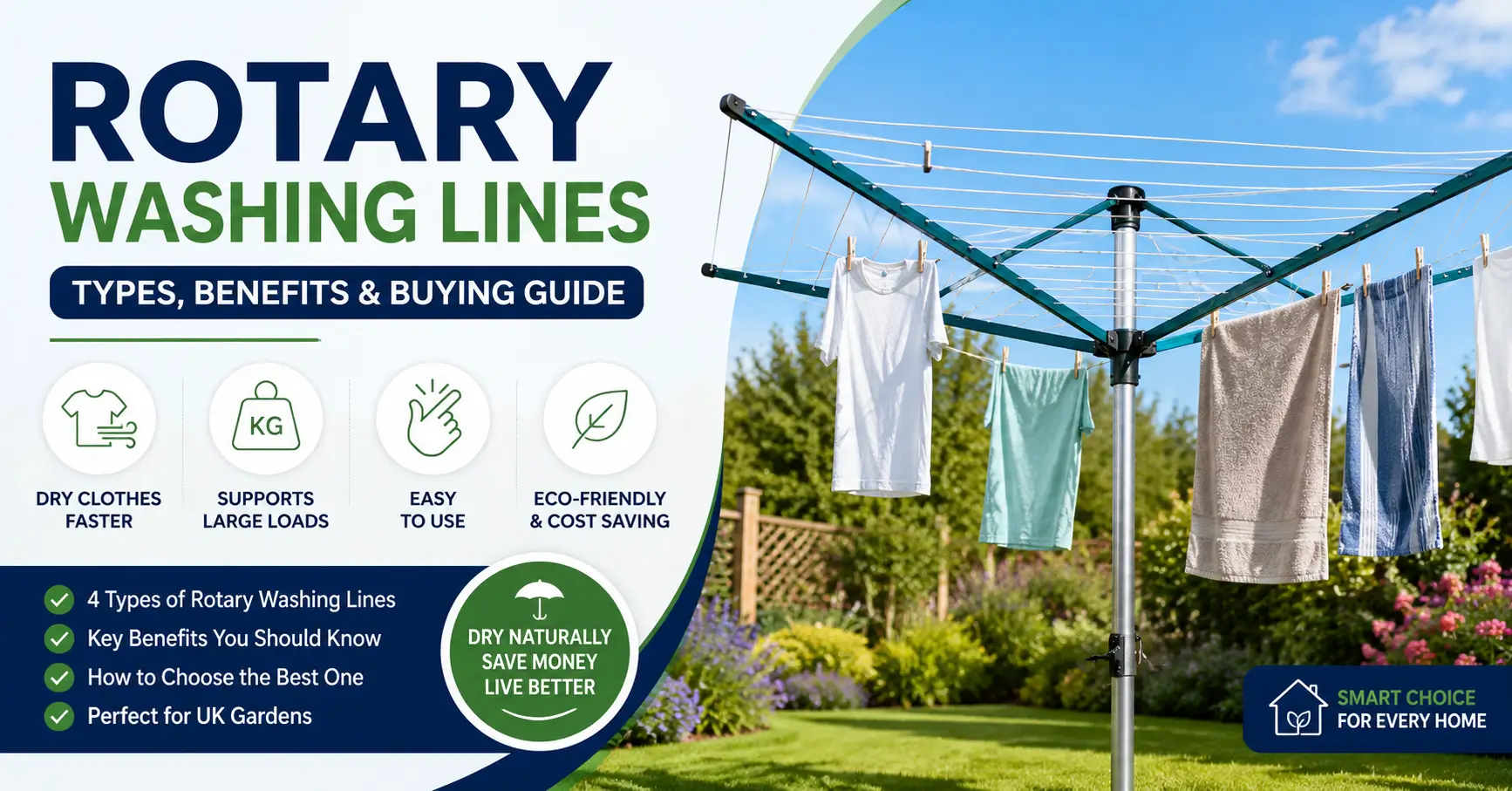
A rotary washing line (also called a rotary dryer) is an outdoor clothes-drying tool. It looks like an umbrella when opened. Most rotary lines have 3, 4, or sometimes 5 arms. Each arm has strong lines where you hang your laundry.
There is a central pole that is installed in the ground. This pole supports the full structure and helps it hold heavy laundry. After use, the rotary washing line can be folded down like an umbrella. Some models are removable, so you can take them out and store them indoors, while others stay outside and can be protected with a cover.
Our another article about Top 12 Best Rotary Washing Line in UK.
History of Rotary Washing Lines
According to Wikipedia, the history of Rotary washing lines started in the late 1800s. In 1895, two men in Australia designed an early rotary clothes drying rack that could turn and tilt. In the early 1900s, an inventor named Gilbert Toyne improved the idea and made several rotary clothes hoists. By 1925, he created a strong all-metal version that could be raised and lowered, making it easier to hang clothes and let the wind dry them faster.
In the 1940s, another inventor, Gerhard “Pop” Kaesler, designed a modern rotary clothesline. He sold his idea to Lance Hill, who began making rotary washing lines in his backyard in 1945. This product later became famous as the Hills Hoist. It became very popular in Australia and was later used in other countries, including the UK, where garden drying is common. Today, rotary washing lines are widely used in the UK because they save space, dry clothes naturally, and reduce electricity use.
4 Types of Rotary Washing Lines
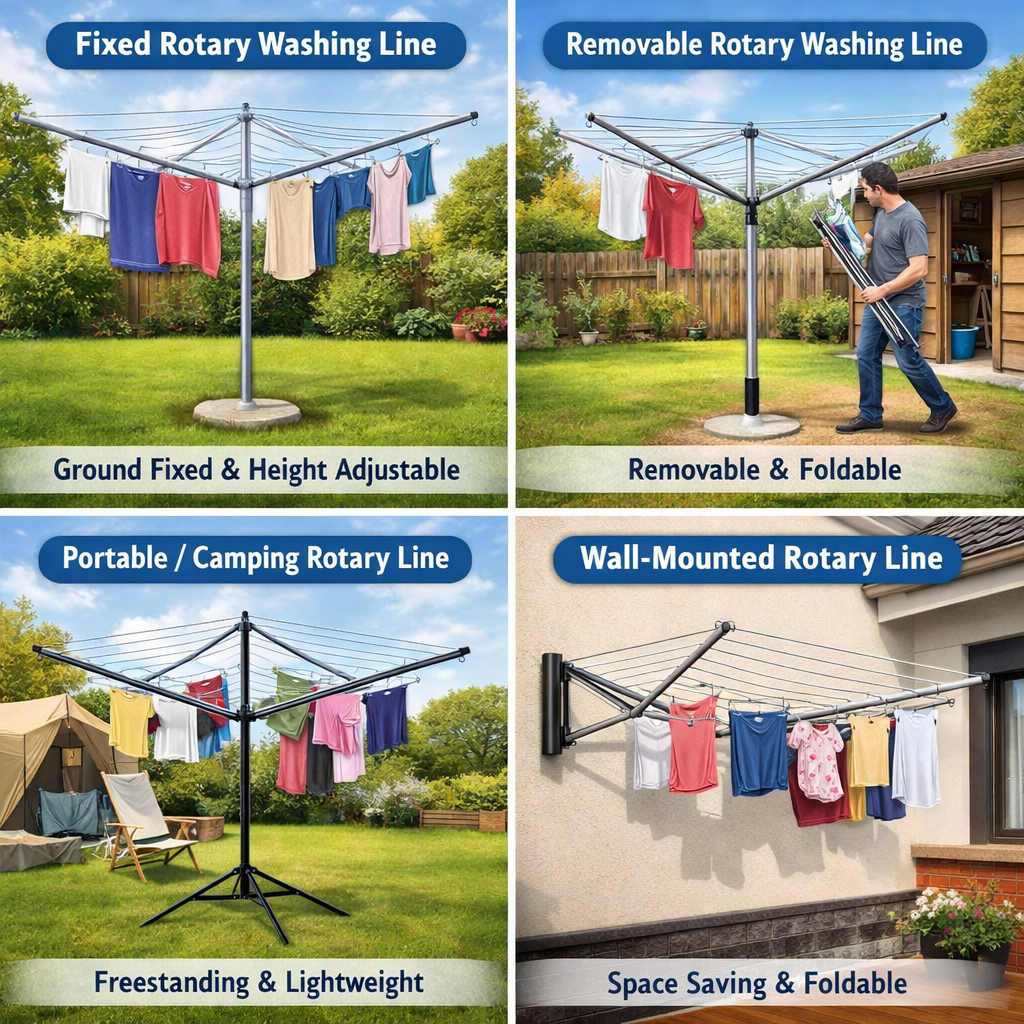
There are 4 main types of rotary washing lines:
1. Ground-Fixed Rotary Washing Line
This is the most popular and strongest type. It is installed permanently in the ground using concrete, which makes it very stable. These models can support heavy laundry loads. Most have a hoist feature, allowing you to lower the arms to hang clothes and raise them again after loading.
2. Removable Rotary Washing Line
This type is similar to the ground-fixed model but can be removed from the ground socket when not in use. It is ideal for small gardens. Many removable models also include a hoist feature for easy height adjustment.
3. Freestanding / Portable Rotary Washing Line
This type does not need ground installation. It has its own legs and can be used indoors or outdoors. It is best for camping, travelling, temporary use, or homes without garden space.
4. Wall-Mounted Rotary Washing Line
This model is fixed to a wall. You open it when needed and fold it away after use. It is perfect for homes with very limited ground space and keeps the garden or patio looking neat and tidy.
To understand these types in detail, check our article Rotary Washing Line Types.
Benefits of Rotary Washing Lines
Dry Clothes Faster
The rotating design allows air and sunlight to reach clothes from all sides, helping them dry faster than traditional straight washing lines.
Supports Large Amounts of Laundry
Most rotary washing lines support 25kg to 85kg, depending on size and build quality. Standard models usually hold 1–2 wash loads, while larger models can handle 4–6 wash loads, including bedding, towels, blankets, and duvets.
Easy to Use
You can stand in one place and rotate the line while hanging clothes. Height adjustment, locking, and folding are simple, just like opening and closing an umbrella.
Saves Space
Even with 30m to 60m of line, rotary washing lines use space efficiently. Many models fold away when not in use, making them ideal for small gardens.
No Electricity Needed
Rotary washing lines use no electricity. Unlike tumble dryers, which can cost around £1 per load, rotary lines are completely free to use.
Gentle on Clothes & Fresh Smell
Natural drying prevents shrinkage, wear, and damage caused by heat. Clothes last longer and smell fresh and clean.
Eco-Friendly & Healthier
No electricity means no pollution. Sunlight also helps kill bacteria and germs, making this a healthier drying method.
Less Ironing
Clothes dry naturally with fewer creases, reducing the need for ironing and saving energy.
Warranty
Most rotary washing lines come with a 5–10-year warranty. Even models with a 1–3 year warranty still offer good value.
How to Choose the Best Rotary Washing Line
1. Space for Your Garden
- Ground-fixed: Best for large gardens
- Removable: Good for small gardens
- Freestanding: Ideal for patios
- Wall-mounted: Best for very small spaces
2. Right Size for Your Family
- 1 person: 20–30m
- 2–3 people: 30–40m
- 4–5 people: 40–50m
- 6+ people: 60m
3. Materials and Accessories
Choose rust-resistant poles, UV-protected lines, strong locking systems, and a protective cover.
4. Design and Features
- Adjustable height
- Folding arms
- Smooth rotation
- Tight line tension
- Breeze brake for wind control
5. Price and Warranty
Avoid very cheap models. Look for good build quality and at least 1 year warranty, ideally 5–10 years.
For full details, read our article Best Rotary Washing Line, where we explain all five points and more in depth.
How to Install a Rotary Washing Line (2 Methods)
Method 1: With Concrete (Best Method)
- Choose a sunny, open area with good airflow
- Remove grass and dig a 30–40cm hole
- Place the ground socket inside
- Pour concrete and use a spirit level
- Leave to dry for 2–3 days.
- Add grass back and insert the washing line
Method 2: Without Concrete
Use a screw-in ground spike:
- Choose flat, firm ground
- Screw the peg into the soil
- Make sure it is tight and stable
- Insert the rotary washing line
Read our full guide, How to Install a Rotary Washing Line in a Garden, for step-by-step instructions for both methods, especially the first one in concrete.
Maintenance and Care Tips
- Clean lines every few days with a damp cloth
- Lubricate moving parts every 1–3 months
- Check for rust or damage regularly
- Use a cover or store indoors when not in use
- Tighten loose lines when needed
- Do not overload beyond weight limits
7 Common Rotary Washing Line Problems (with Solutions)
1. Won’t Go Up – Causes are tangled lines, lines too tight, or stuck mechanism.
Fix: Untangle lines, loosen tight ones, clean and lubricate the mechanism.
2. Sagging Lines – Lines stretch or hold heavy clothes.
Fix: Remove clothes, tighten each line from bottom to top and check tension.
3. Rust & Corrosion – Metal parts rust over time.
Fix: Use rust-resistant lines, clean & dry metal, cover when not in use, or use plastic lines.
4. Won’t Spin – Mechanism gets stiff due to dirt or rust.
Fix: Clean and lubricate moving parts.
5. Leaning Posts – Posts tilt if not installed properly.
Fix: Use a water level, firm soil, or concrete supports when installing.
6. Wind Damage – Strong winds twist or break lines.
Fix: Take laundry in, lower or remove the line during heavy winds, check for damage after storms.
7. Broken Lines – Lines snap if old or overloaded.
Fix: Replace only the line; the rest of the washing line is fine.
These are just quick details to understand the problems. For full solutions, check our article ‘7 Common Rotary Washing Line Problems (with Solutions)
Rotary Washing Line vs Tumble Dryer: Are Rotary Washing Lines Better?
A rotary washing line is often a better choice than a tumble dryer because it is cheaper, eco-friendly, and gentler on clothes. It uses no electricity, so your energy bills stay low, and drying outside on fresh air prevents shrinkage and fabric damage. Clothes also get a fresh, natural smell, and the line requires very little maintenance compared to a tumble dryer.
While a tumble dryer is faster and useful in bad weather, a rotary line is better for the environment and your wallet, making it ideal if you have a garden or outdoor space and don’t mind waiting for clothes to dry naturally.
How to Restring a Rotary Washing Line?
To restring, rewire, or thread a rotary washing line, start by removing the old line completely. Measure the length you need for the new line, allowing a little extra for knots and threading. Check the rotary frame for any damage, loose screws, or rust, and clean or tighten it if necessary. This ensures the new line lasts longer and the dryer works safely.
Next, thread the new line through the arms of the rotary dryer. You can do this one arm at a time or all around at once, depending on what is easier. Make sure the line is firm but still has a little bounce, then tie strong knots at the ends and trim any extra. Finally, test the line by hanging a few light clothes and adjust the tension if needed. Properly fitted, your washing line will rotate smoothly and last for years.
For full setup, visit our article How to Restring a Rotary Washing Line.
Rotary Washing Line 5 Disadvantages
High Buying Cost
Rotary washing lines can be expensive to buy at first. Budget models start from around £24, but these are only good for light laundry. The average price is usually £80 to £100. If you choose a strong aluminium rotary line that supports heavy loads, is easy to open and close, and has a stylish design, the price can go above £200. A good example is the Leifheit Linomatic rotary washing line.
Installation Takes Time
Another disadvantage of a rotary washing line is that it takes time to install. You need to dig a hole, add concrete, and then wait a few days for the concrete to dry. This can feel frustrating, but it is a one-time job.
Always Visible in Your Garden
If the rotary washing line is fixed in the ground, it will always be visible in your garden. This is unlike retractable washing lines, which can be hidden when not in use.
Not Ideal for Large Items
Rotary washing lines work well for small clothes, but large items like bedsheets can be hard to hang. Large items may not dry evenly because the inner lines get less air and sunlight than the outer lines. This can cause slower drying.
Maintenance
After some time, the lines can stretch. When this happens, you will need to restring the lines to keep the washing line working properly.
Rotary Washing Line vs Retractable Washing Line
A rotary washing line has a central pole with arms that rotate 360°. This lets sunlight and wind reach clothes from all sides for faster drying. It can fold down when not in use.
A retractable washing line is a cord that pulls out from a small case. You hang clothes, then roll them back when done. Usually has 1–2 lines.
7 Key Differences
- Cost – Rotary is pricier (£20–£200+), retractable is cheaper (£10–£120).
- Space – Rotary saves space vertically, retractable needs more horizontal space.
- Installation – Rotary requires digging and concrete; retractable is quick and wall-mounted.
- Drying Speed – Rotary is faster due to rotation; retractable is slower.
- Load Capacity – Rotary holds 4–6 loads; retractable 1–2 loads.
- Weather Use – Rotary can use a rain cover; retractable cannot.
- Foldable/Space-Saving – Both save space; rotary folds, retractable rolls up.
In short: Rotary lines dry faster, handle more laundry, can use rain covers, and save vertical space, but cost more and take longer to install. Retractable lines are cheaper, easier to install, and tidier, but slower, hold fewer clothes, and cannot stay out in the rain. Choose rotary for speed and bigger loads, retractable for cost and convenience.
FAQs
Can I use the Rotary Washing Line indoors?
Yes, you can use a freestanding rotary washing line indoors, as it stands on its legs. You can also use it outdoors when there is sun and fresh air. After using it outside, you can fold it and bring it back indoors. These lines are also useful for travelling, camping, and other outdoor activities.
How much Weight Can a Rotary Washing Line Hold?
A rotary washing line can usually hold between 10kg and 30kg of clothes, depending on how big and strong it is. A normal 4-arm line with 40–50 metres of washing line can take about 10kg to 17kg of wet laundry. Stronger, heavy-duty lines, like a 50-metre 4-arm version, can hold 30kg to 50kg. Some special or industrial lines are even stronger and can carry over 100kg. How much it can hold mainly depends on the number of arms, the total line length, and how sturdy the line is.
Hi, this is a comment.
To get started with moderating, editing, and deleting comments, please visit the Comments screen in the dashboard.
Commenter avatars come from Gravatar.