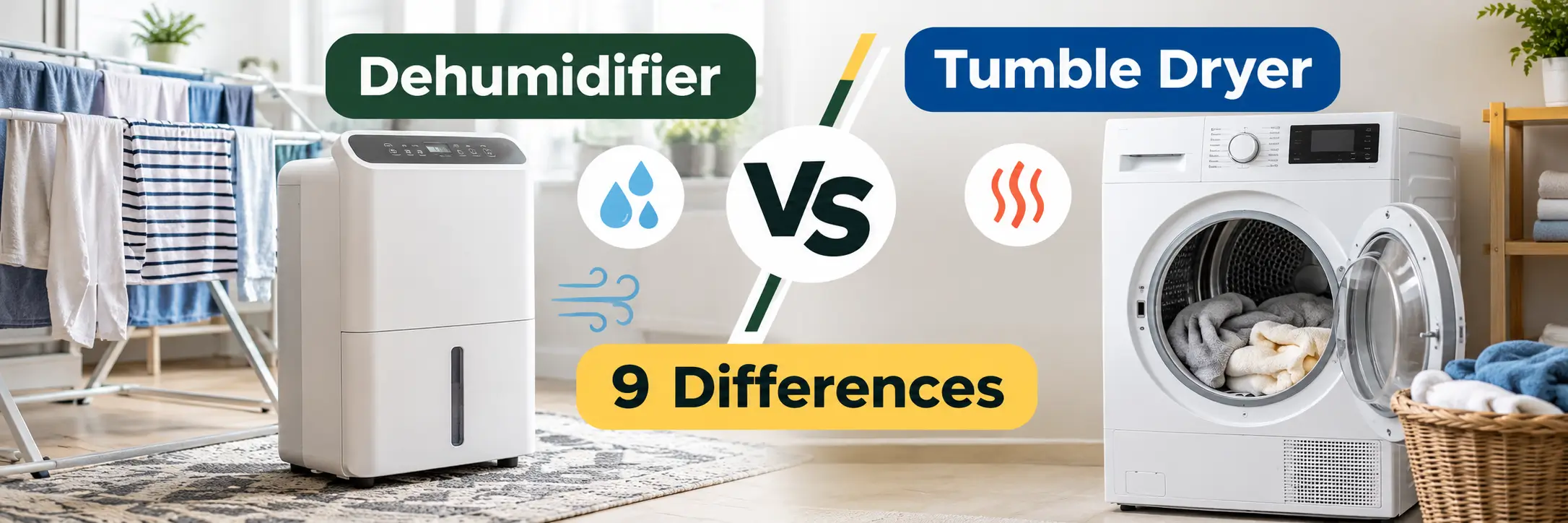
Dehumidifier vs Tumble Dryer (9 Difference)
The short answer to dehumidifier vs tumble dryer is this: if you do not mind waiting a little longer and are happy to spend some time setting things up, a dehumidifier is the better option and the overall winner. It offers several benefits, including gentle drying, handling large laundry loads, reducing damp, improving indoor air quality, and lower running costs than a traditional tumble dryer. Its running costs are also almost the same as those of a modern heat pump tumble dryer.
On the other hand, a tumble dryer dries clothes much faster, usually within 1–2 hours, and requires very little effort. However, apart from these two benefits, a tumble dryer falls behind a dehumidifier in most other areas.
Below, we discuss all these differences in more detail to help you decide which option is best for you and to give you a clear final choice.
How we wrote this article: We read many trusted websites, articles, forums, and watched videos. We also used our own knowledge. By putting all this together, we created one clear and helpful article for you. Instead of reading many websites, forums, and videos, this single article is enough to help you understand the topic and choose the best option for you.
- Dehumidifier
- Tumble Dryer and Types
- Which One Is Cheaper to Buy?
- Which One Dries Clothes Faster?
- Which One Is Cheaper to Run?
- Which One Is Gentle on Clothes?
- Which One Is Easy to Use?
- Which One Is Better for Small Spaces?
- Which One Is Noisier?
- Which One Dries More Clothes?
- Best Season to Use
- Final Point: Which Is Best?
Dehumidifier
A dehumidifier is a device that takes water (moisture) out of the air. In homes, it helps prevent dampness, mould, and keeps the air fresh, a dehumidifier focuses on reducing humidity in the room, which can indirectly help laundry dry faster if placed in the same space. Some models have a “laundry mode” that increases airflow and optimises humidity reduction, making it easier and faster to dry clothes indoors.
Tumble Dryer and Types
A tumble dryer is a home appliance used to dry wet clothes after washing. It works by spinning clothes in a rotating drum while warm air blows inside. The heat removes water from the clothes, and the moisture is sent out through a vent or collected in a water container, depending on the model. Before comparing dehumidifiers vs tumble dryers, we need to understand the different types of tumble dryers.
There are 3 main types of tumble dryers:
Vented Dryers
Push moist air outside through a hose, so they need a vent or window; they are the fastest and cheapest to buy, but use more energy around £1.23 to £1.32 per cycle.
Condenser Dryers
Collect water in a container, do not need a vent, are easy to place anywhere with a plug socket, and dry clothes fairly quickly, but they cost more to run, around £1.29 to £1.34 per cycle.
Heat Pump Dryers
Reuse warm air, making them the most energy-efficient and cheapest to run at 20-60p per cycle; they are gentler on clothes, take longer to dry, and cost more to buy.
Let’s discuss the 9 differences between a Dehumidifier and a Tumble Dryer
| # | Difference | Winner |
|---|---|---|
| 1 | Cheaper to buy | Dehumidifier |
| 2 | Dries clothes faster | Tumble Dryer |
| 3 | Cheaper to run | Draw (with heat pump dryers) |
| 4 | Gentle on clothes | Dehumidifier |
| 5 | Easy to use | Tumble Dryer |
| 6 | Small spaces and storage | Dehumidifier |
| 7 | Quieter | Dehumidifier |
| 8 | Dries more clothes | Dehumidifier |
| 9 | Best season to use | Dehumidifier (winter) |
1Dehumidifier vs Tumble Dryer: Which One Is Cheaper to Buy?

The upfront buying price of a dehumidifier with laundry drying mode generally costs between £100 and £250. The final price depends on features. However, the starting price is from £50 up to a maximum of £400. Most dehumidifiers have a 1–2 year warranty for fixing the fan or motor, but for more expensive models, it increases to 5–10 years.
On the other hand, tumble dryers cost between £200 and £1,000+, and some premium models can cost £2,000+. Prices depend on the type, and most tumble dryers come with a 1–2 year warranty.
Vented Dryers
They are the cheapest to buy, but running costs are high.
Condenser Dryers
Heat Pump Dryers
Some premium models can cost £2,000+. But the best thing is that they have the lowest running costs, almost like a dehumidifier.
2Dehumidifier vs Tumble Dryer: Which One Dries Clothes Faster?

A tumble dryer dries clothes much faster than a dehumidifier. Drying times vary by type:
Vented dryer, per load
Condenser dryer, per load
Heat pump dryer, per load
On the other hand, a dehumidifier dries clothes slowly. If you use our recommended best method to dry clothes with a dehumidifier, it takes 3–6 hours for normal clothes and up to 12 hours for larger items like towels, jeans, or bedding. If you leave the clothes overnight, almost all of them will be dry by morning. We also tried this method, and it works well.
30–120 minutes, while a dehumidifier takes 3–6 hrs.
3Dehumidifier vs Tumble Dryer: Which One Is Cheaper to Run?
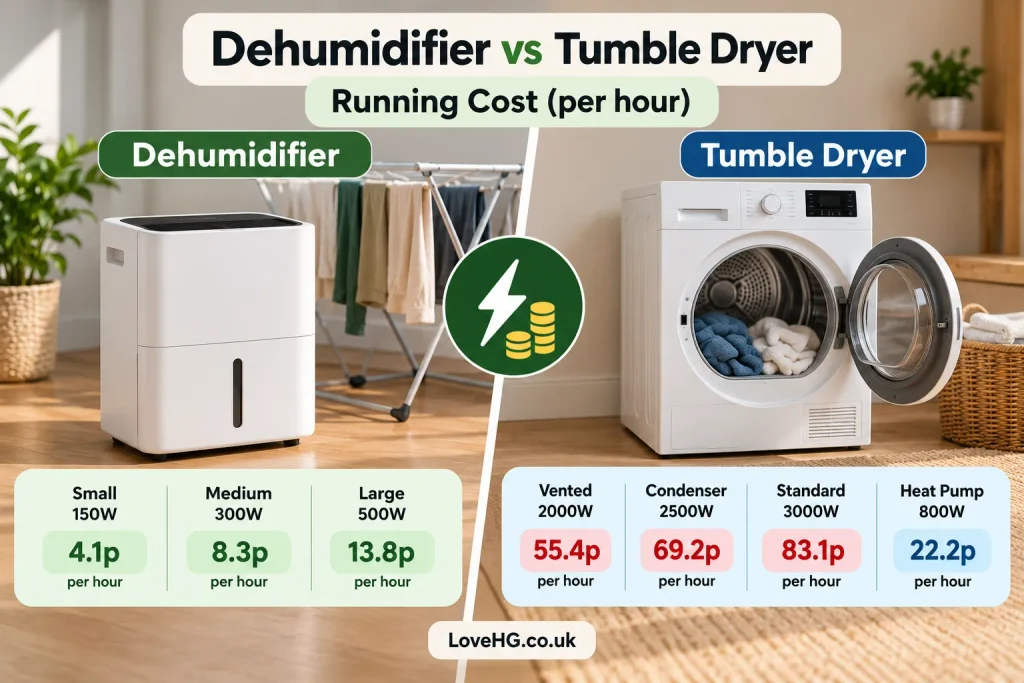
As discussed above, there are three types of tumble dryers. If we compare a dehumidifier with vented and condenser dryers, the dehumidifier is usually the winner. However, if we compare a dehumidifier with a heat pump tumble dryer, they are almost the same, as the cost depends on the model. So, we consider both a Draw. Let’s discuss this in more detail below:
According to the UK Official website OFGEM.gov.uk, the electricity rate is 26.32 pence per kWh from 1 October to 31 December 2026. To find the exact hourly running cost, the formula is:
Costs are rounded to 1 decimal place.
A. Dehumidifier Hourly Costs in the UK:
| Dehumidifier | Formula | Cost per hour |
|---|---|---|
| Small 150 W | 150 ÷ 1000 × 26.32 = £0.039 | 3.9p |
| Medium 300 W | 300 ÷ 1000 × 26.32 = £0.079 | 7.9p |
| Large 500 W | 500 ÷ 1000 × 26.32 = £0.132 | 13.2p |
B. Tumble Dryer Hourly Costs in the UK:
| Tumble Dryer | Formula | Cost per hour |
|---|---|---|
| Small 2000 W | 2000 ÷ 1000 × 26.32 = £0.526 | 52.6p |
| Medium 2500 W | 2500 ÷ 1000 × 26.32 = £0.658 | 65.8p |
| Large 3000 W | 3000 ÷ 1000 × 26.32 = £0.790 | 79.0p |
| Heat pump 800 W | 800 ÷ 1000 × 26.32 = £0.211 | 21.1p |
C. Comparison Over Typical Usage Times:
| Appliance | Shorter run | Longer run |
|---|---|---|
| Dehumidifier – typically runs 3–6 hours per session | ||
| Small 150 W | 3h → 11.8p | 6h → 23.7p |
| Medium 300 W | 3h → 23.7p | 6h → 47.4p |
| Large 500 W | 3h → 39.5p | 6h → 79.0p |
| Standard tumble dryer – runs 1–2 hours per load | ||
| Small 2000 W | 1h → 52.6p | 2h → 105.3p |
| Medium 2500 W | 1h → 65.8p | 2h → 131.6p |
| Large 3000 W | 1h → 79.0p | 2h → 157.9p |
| Heat pump tumble dryer – runs 1–2 hours per load | ||
| Heat pump 800 W | 1h → 21.1p | 2h → 42.1p |
Dehumidifier vs Vented/Condenser Tumble Dryer
Conclusion: A dehumidifier is usually cheaper than a standard vented or condenser tumble dryer, especially when drying several loads at one time.
Dehumidifier vs Heat Pump Tumble Dryer
Observation: For shorter sessions (3 hours), a medium dehumidifier (~24p) is slightly more expensive than 1-hour heat pump dryer (21p). But for longer sessions (6 hours), the dehumidifier is comparable or slightly higher. Depending on usage, dehumidifier and heat pump tumble dryer could be similar in running costs for a typical drying cycle.
D. Summary:
In the UK, electricity costs 26.32p per kWh. Small, medium, and large dehumidifiers cost 4p, 8p, and 13p per hour, while standard tumble dryers cost 53–79p per hour and heat pump dryers 21p per hour. Dehumidifiers run 3–6 hours, making them usually cheaper than standard dryers, while heat pump dryers and dehumidifiers have similar costs depending on session length.
E. Winner of Cheaper to Run:
- Dehumidifier vs Vented/Condenser Tumble Dryer → Dehumidifier usually wins
- Dehumidifier vs Heat Pump Tumble Dryer → Draw
4Dehumidifier vs Tumble Dryer: Which One Is Gentle on Clothes?

When it comes to being gentle on clothes, a dehumidifier is the better option. It dries laundry using dry air rather than high heat, which helps protect fabrics from shrinking, fading, or wearing out. This makes it ideal for delicate items, everyday clothing, and clothes you want to last longer.
A tumble dryer uses heat and constant tumbling, which can be harsher on fabrics over time. While modern dryers have gentle settings, some clothes are not suitable for tumble drying at all, such as wool, silk, and items with special care labels. In short, if fabric care matters most, a dehumidifier is the gentler and safer choice.
5Dehumidifier vs Tumble Dryer: Which One Is Easy to Use?

A tumble dryer is generally easier to use because you just load your clothes, choose a setting, and press start, with no extra steps. Most machines have simple controls and automatic sensors that stop when clothes are dry.
A dehumidifier, on the other hand, requires more effort to use effectively for drying clothes. You need to hang your laundry on a rack or airer in a small room, place the dehumidifier a suitable distance away, and sometimes use a fan to improve airflow. You may also need to adjust settings or empty the water tank, depending on the model. It takes a bit more setup and attention than a tumble dryer.
6Dehumidifier vs Tumble Dryer: Which One Is Better for Small Spaces and Easy to Store?
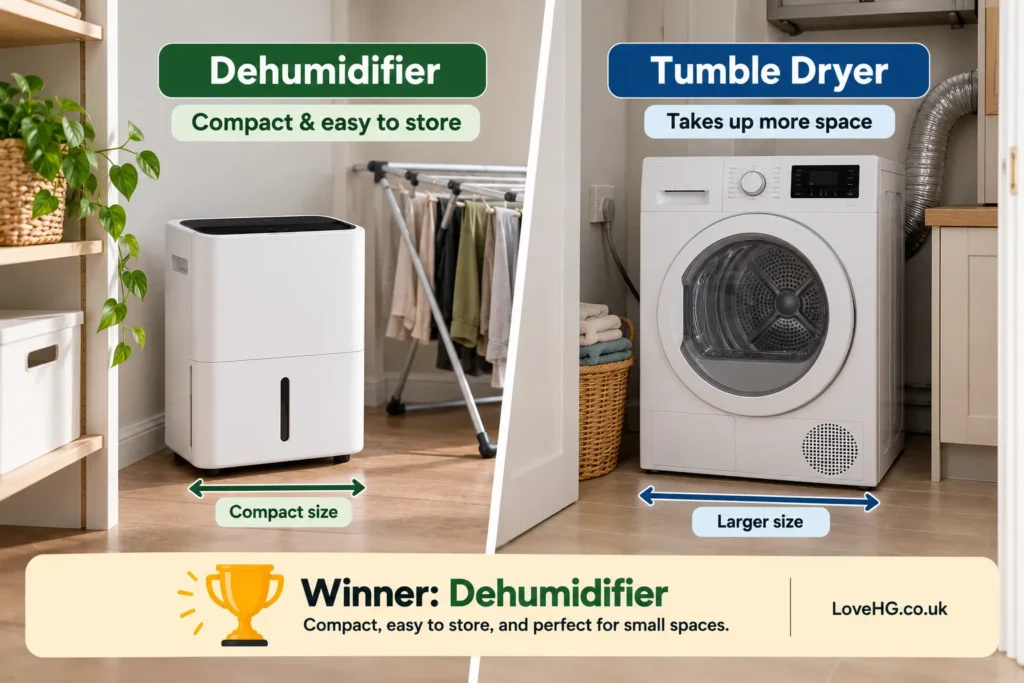
A tumble dryer usually takes up more space and is harder to fit into small homes or flats. Vented or condenser models often need plumbing connections or proper venting, and once installed, they are difficult to move. This makes them less flexible and not ideal for homes where space is limited or layouts change frequently.
A dehumidifier, in contrast, is compact and easy to store. Most models can fit in a small room or utility cupboard, which can also be used in bathrooms, utility rooms, or even bedrooms and can be moved from room to room as needed. It doesn’t require special installation or ventilation, making it a better choice for homes with limited space or for those who want a versatile appliance that can be used elsewhere after drying laundry.
Compact, easy to store, and perfect for small spaces.
7Dehumidifier vs Tumble Dryer: Which One Is Noisier?
Tumble dryer
Dehumidifier
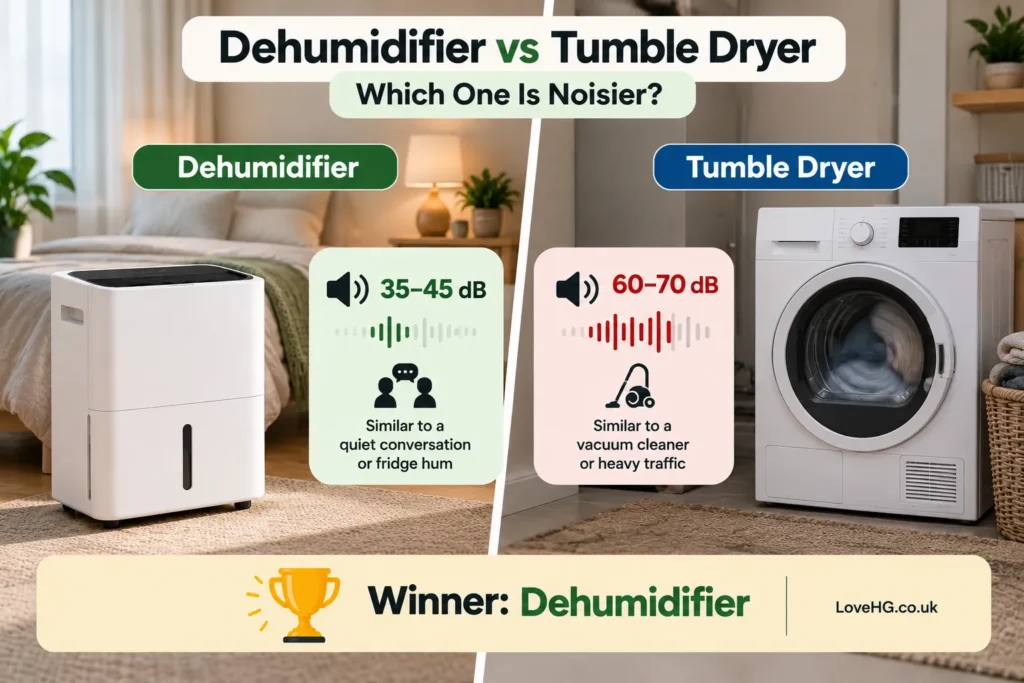
A tumble dryer is usually quite noisy, producing around 60–70 dB, similar to a vacuum cleaner or heavy traffic. The noise comes from the spinning drum, motor, and airflow. Because of this noise, it’s not suitable for places like bedrooms, living rooms, or small flats, especially at night. Most people place tumble dryers in a utility room, garage, or separate laundry area where the noise won’t be disturbing.
A dehumidifier, on the other hand, is much quieter, typically running at 35–45 dB, which is closer to a quiet conversation or fridge hum. This low noise level means you can safely use it in bedrooms, living rooms, bathrooms, or even overnight without much disturbance. Its quiet operation and flexibility make it easier to use anywhere in the home.
8Dehumidifier vs Tumble Dryer: Which One Dries More Clothes?

A dehumidifier can usually dry more clothes at once compared to a tumble dryer. It is perfect for bigger families. You can hang multiple loads, around 4 to 5 washing loads or even more, on an airer in a small room, and the dehumidifier will dry them all. Using a fan with the dehumidifier gives an extra boost, helping clothes dry faster and more evenly. This makes it easy and quick to handle large amounts of laundry at once.
A tumble dryer, on the other hand, can usually dry only around 9 kg of clothes per cycle. If you have more laundry, you will need to run multiple cycles. This not only takes more time but also increases electricity costs. For homes with lots of washing, a tumble dryer may be less convenient compared to a dehumidifier.
It handles larger amounts of laundry at once, making it better for families or anyone with lots of washing.
9Dehumidifier vs Tumble Dryer: Best Season to Use

A dehumidifier works best in winter and cold months (December – February in UK) and early spring (March), when indoor air is damp, and drying clothes outside is slow or impossible. It helps reduce condensation, mould and dries clothes indoors efficiently.
Tumble Dryer can be used year-round, but is especially useful in cold, wet, or humid months (October – April) when outdoor drying isn’t practical. In summer and warm months (May – September), a tumble dryer may be less needed if you can hang clothes outside.
Tumble dryer is versatile but more essential for quick drying when the weather is wet or damp.
Final Point: Which one is the best Dehumidifier or Tumble Dryer?
🏆 Choose a Dehumidifier if…
If you are happy for clothes to take more time, around 3 to 6 hours, and you are OK with a bit of extra setup, such as hanging clothes on an airer, then a dehumidifier is the best option. Apart from these two points – longer drying time and slightly more effort – the other aspects of a dehumidifier are positive, such as a lower upfront cost, easy setup anywhere in the home, low noise levels, being gentle on clothes, and drying more clothes.
⚡ Choose a Tumble Dryer if…
On the other hand, a tumble dryer dries clothes much faster, usually within 1 to 2 hours, and needs very little effort. However, the downsides are the high upfront cost, the need for a separate space because it is large and noisy, not ideal for a large family with laundry, and the fact that it can be harsh on some clothes (not all, but certain fabrics).
18 Ways to Dry Clothes Indoors:
Did you know that a dehumidifier and tumble dryer are not the only ways to dry clothes indoors? There are many other methods:
- Dehumidifier + Fan + Airer
- Indoor Rotary Clothes Line
- Retractable Washing Line
- Wall-Mounted Airer
- Ceiling-Mounted Pulley Airer
- Travel Washing Line
- Heated or Non-Heated Clothes Airer
- Drying Pod
- Heated Towel Rail
- Radiator or Over-Door Airer
- Over-Bath Airer
- Peg Hanger
- Hair Dryer + Towel
- Iron + Towel
- Tumble Dryer
- Washer-Dryer
- Heated Drying Cabinet
- Laundrette
To learn more about these 18 methods in detail, read our full guide:
18 Ways to Dry Clothes Indoors